

Compliance Corner.
IN-DEPTH GUIDANCE. EVERY MONTH.
In the United States, hazardous wastes are subject to regulations mandated by the Resource Conservation and Recovery Act (RCRA). Every month, we provide clear, in-depth guidance on a different aspect of the RCRA regulations. The information presented here is an excerpt from McCoy’s RCRA Unraveled, 2024 Edition.
©2024 McCoy and Associates, Inc. All rights reserved.
Training
The RCRA regulations include personnel training requirements designed to reduce the potential for mistakes and accidents at hazardous waste facilities that might threaten human health or the environment. The purpose of these programs is to ensure that workers are adequately prepared to properly manage hazardous waste during normal operations and also respond to any emergencies. The following regulated parties must comply with RCRA training standards:
- LQGs [§262.17(a)(7)];
- SQGs [§262.16(b)(9)(iii)];
- Permitted TSDFs [§264.16];
- Interim status TSDFs [§265.16]; and
- Universal waste handlers [§§273.16 and 273.36].
VSQGs are not subject to any RCRA training requirements. [RO 14687]
The training requirements for LQGs, permitted TSDFs, and interim status TSDFs are essentially identical (except that permitted facilities must include additional information in their Part B permit applications). SQGs and small and large quantity handlers of universal waste are subject to less-stringent training standards designed to reduce their administrative burden (especially with regard to recordkeeping). Training requirements applicable to each of these groups are examined on the following pages.
Large quantity generators
Under §262.17(a)(7), LQGs who accumulate hazardous waste onsite for 90 days or less without a permit or interim status must comply with significant personnel training requirements. EPA justified making LQGs comply with essentially the same training standards as TSDF personnel by noting, “there is little difference between accumulation of hazardous waste for shipment offsite and storage so far as potential damage to human health and the environment is concerned. Therefore, the same standards…should apply.” [May 19, 1980; 45 FR 33141] The §262.17(a)(7) training requirements are summarized below.
Who must be trained?
Section 262.17(a)(7)(i)(A) requires facility personnel receive some type of training. EPA defines “facility personnel” in §260.10 as “all persons who work at, or oversee the operations of, a hazardous waste facility, and whose actions or failure to act may result in noncompliance with the requirements of Part 264 or 265….” If that definition seems a little unclear with regard to who needs to be trained, EPA was purposely vague: “Given the variability in waste types, management processes, and employee functions at hazardous waste facilities, the agency believes that it is neither necessary nor desirable to rigidly specify training courses in [the] regulations.” [May 19, 1980; 45 FR 33182]
Instead, the type and degree of training required will depend on each employee’s responsibilities associated with his/her job function/description. “[I]t would not make sense to require training in topics not germane to an employee’s areas of responsibility since this would add considerable burden to some firms without corresponding environmental or health benefits…. [I]mplicit in the regulations is the requirement that the type and amount of training necessary for each employee stems from his specific responsibilities.” [March 24, 1986; 51 FR 10165]
EPA noted all personnel (supervisors as well as nonsupervisory personnel) who are actively engaged in the operation of the hazardous waste facility require training. [OSWER Directive 9523.00-10, cited previously] Certainly, workers that directly manage hazardous waste (including laboratory technicians) must receive training on the hazardous waste management procedures relevant to their individual responsibilities. [RO 12341] In addition to the existing training elements for LQG facility personnel at §262.17(a)(7)(i)(C), the agency noted in guidance that training would be beneficial for personnel who:
- Complete and/or sign hazardous waste manifests,
- Manage hazardous waste in accumulation areas,
- Maintain hazardous waste inventories,
- Conduct daily or weekly inspections of hazardous waste accumulation areas, and
- Plan for or respond to hazardous waste emergencies. [81 FR 85797]
What about other plant workers (e.g., maintenance personnel) whose job functions preclude them from actually managing hazardous waste? EPA noted in preamble language, “Employees who work in or adjacent to areas where hazardous wastes are generated, handled, or stored but do not handle hazardous wastes, must still be trained to be thoroughly familiar with basic emergency procedures.” [March 24, 1986; 51 FR 10165]
Personnel responsible for managing hazardous waste documentation should also receive training, even though they may not directly handle wastes. For example, clerical staff responsible for maintaining manifest and LDR records should be trained on the necessity of the paperwork and appropriate methods and time frames for maintaining the records.
At a minimum, all employees, regardless of their position, must be familiar with the facility’s contingency plan and evacuation procedures so that they can respond effectively in an emergency. Clerical and office workers must receive this training as well as hazardous waste workers. [OSWER Directive 9523.00-10] If an incident occurs, most personnel will be responsible for vacating the premises according to the facility’s evacuation plan. In the meantime, other facility personnel who have received more extensive emergency response training, will be responsible for containing any spills, informing the police and fire department, and/or operating fire-fighting or other emergency response equipment.
Part-time and temporary employees must also receive appropriate training. [March 24, 1986; 51 FR 10165]
Finally, contractors working at LQG sites fall under the §260.10 definition of “facility personnel” and consequently must receive RCRA training. [RO 14180] As such, contractors should be trained in certain areas (e.g., evacuation routes, emergency communications/alarms, proper hazardous waste handling practices) before they begin work. One way to facilitate such training is for the facility to require contractors to take general hazardous waste or health and safety training as a condition of the contract. Although not required by the regulations, it is good practice for facility personnel to supervise contractors, ensuring they properly manage any hazardous wastes they generate or handle.
Training exception for satellite accumulation areas
RCRA training is not required for personnel whose hazardous waste management activities are limited to working in or near SAAs. EPA noted, “since only one waste will normally be accumulated at each satellite area, and since only limited quantities are allowed to accumulate,... training plans are not necessary.” However, when waste generated in a SAA is moved to a 90/180/270-day accumulation area or to permitted or interim status storage, the RCRA training requirements will apply (including training for those who transfer the waste from satellite areas to CAAs). [January 3, 1983; 48 FR 119, December 20, 1984; 49 FR 49570, RO 11373, 14703, 14758]
Although not a regulatory requirement, EPA encourages generators to ensure employees who work in areas where hazardous waste is accumulated, including SAAs, receive sufficient training to ensure that they are familiar with proper handling and emergency procedures. [81 FR 85797]
When must training be completed?
Personnel must successfully complete initial training within 6 months after they are employed or assigned a new position at the facility. [§262.17(a)(7)(ii)] New employees who will be performing hazardous waste management tasks must be supervised at all times until they have completed the initial training. This requirement is not extended to existing employees who transfer into the hazardous waste area; however, we recommend transferees also not work unsupervised until their training is complete.
After the initial training, personnel must participate in an annual training review specific to the individual employee’s hazardous waste duties. This refresher training is required to keep personnel up-to-date with changes in wastes managed at the facility, state and federal RCRA regulations, operating or paperwork procedures, the facility’s contingency plan, etc. The regulations in §262.17(a)(7)(iii) do not specify the amount of time associated with this annual review training.
What are the basic RCRA training requirements?
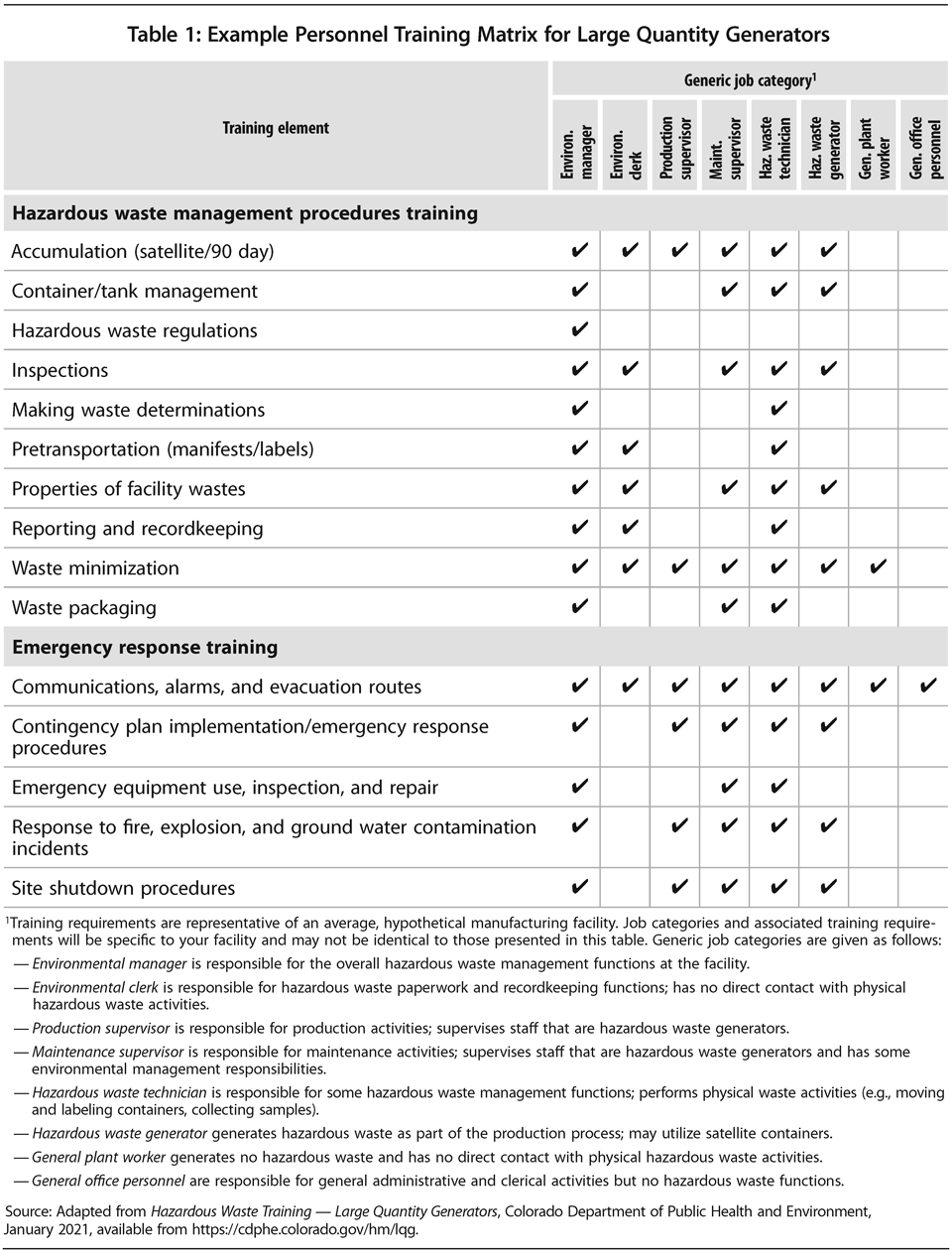
Section 262.17(a)(7)(i)(B) requires training in two primary areas: 1) hazardous waste management procedures, and 2) emergency response. A good place to start is with guidance provided by the state of Colorado (see Table 1) on the training that should be provided for different job categories at LQG facilities.
Hazardous waste management procedures training
EPA requires facility personnel to successfully complete classroom instruction, online training (e.g., computer-based training), or an on-the-job training program that teaches them to perform their duties in a way that ensures the facility’s compliance with the RCRA regulations. This component of the training program must be designed to ensure workers are able to safely handle hazardous wastes. Training must cover the hazardous waste management procedures relevant to the functions that the employees perform at the facility (e.g., accumulation standards, container and tank management, inspections, manifests, packaging, waste identification and determinations).
These training sessions should cover topics such as [OSWER Directive 9523.00-10]:
- The chemical and physical characteristics of the wastes that the workers are assigned to manage (e.g., ignitability, reactivity, incompatibility with other waste types);
- Knowledge of what to do if a spill or leak occurs;
- The types of protective equipment (e.g., respirators, self-contained breathing apparatus) or clothing to be worn during routine and emergency situations;
- Proper operation of trucks, forklifts, or any other machinery used in waste management;
- Basic first aid; and
- Who to inform if an emergency occurs.
During training, employees should be taught not only how, but why, certain operations are to be performed in a prescribed manner. Providing personnel with such explanations should reduce the use of short-cuts that may lead to problems. Furthermore, training should “be structured so that it parallels as realistically as possible the actual job in order that the ‘real world’ activities are approximated as much as possible.” [OSWER Directive 9523.00-10]
Emergency response training
All facility personnel must receive some type of emergency response training to ensure that they can effectively respond to emergencies. Section 262.17(a)(7)(i)(C) and associated guidance require that facility personnel be trained on the following topics, depending on the employee’s job description:
- Contingency plan content and implementation;
- Communication and alarm systems;
- Standard operating procedures for using, inspecting, repairing, and replacing facility emergency and monitoring equipment;
- Key parameters for automatic-waste-feed cut-off systems;
- Use and limitations of personal protective equipment;
- Appropriate responses to fires, explosions, and ground water contamination incidents; and
- Shutdown of operations.
EPA provided specific training requirements in §262.17(a)(7)(i)(C) for this aspect of the facility’s training program. The agency believes the ability to respond to emergencies is the most important skill that facility personnel must acquire to minimize the potential dangers associated with hazardous waste management.
LQGs also have to satisfy the training requirements of the OSHA HAZWOPER program (29 CFR 1910.120). HAZWOPER training is required only for facilities that have the potential for an emergency to occur due to an uncontrolled release of hazardous substances or hazardous raw materials. It requires training to make sure that employees can recognize and respond to an emergency.
In an April 4, 2006 final rule [71 FR 16862], EPA modified the regulations to give facilities the option of complying with either the RCRA or OSHA training requirements for emergency procedures. If a facility can meet all RCRA emergency response training requirements through an OSHA training course, the facility would be in compliance with RCRA. On the other hand, if a facility cannot meet all required RCRA emergency response training through such OSHA training, then it would be incumbent on the facility to address any gaps. [71 FR 16871] EPA recommends generators work with their state agency or EPA regional office to ensure the approach they take in developing an emergency response training program is in compliance with §262.17(a)(7). Obviously, facilities not subject to OSHA training requirements would have to comply with the RCRA training standards.
In RCRA-OSHA Training Requirements Overlap, May 27, 1999 (available at http://www.understandrcra.com/rccd/RCRA-OSHA-overlap.pdf), EPA said RCRA training requirements are more stringent than OSHA in the following areas:
- Reach of employees required to be trained,
- Scope of training on standard operating procedures,
- Extent of training on automatic-waste-feed cut-off systems,
- Response to ground water contamination incidents,
- Scope and length of time for training record retention, and
- Recordkeeping regarding who has been trained.
Therefore, although significant overlap exists, OSHA HAZWOPER training alone may not satisfy all of the RCRA training requirements. In addition, RCRA training must be tailored to the site-specific hazardous waste duties of facility personnel.
Four training options available
Initial and annual review training may be performed via 1) formal classroom programs offered offsite, 2) in-house classroom sessions, 3) online training (e.g., computer-based training), or 4) in-house, on-the-job learning. A combination of these four options may be used. Some facilities opt to send their supervisory personnel to formal, offsite training programs so that they can come back and train the remaining facility personnel in more focused, in-house training sessions. In addition to on-the-job (hands-on) learning, in-house training can consist of regularly scheduled meetings, such as monthly safety meetings, computer-based training, electronic memos, videos, or read-only training materials. The effectiveness of such training can be measured by performance or by written/oral tests.
EPA recognizes supervised on-the-job training is a valid substitute for, or supplement to, formal classroom training. However, the agency stipulated in the preamble to the May 19, 1980 RCRA regulations that “the content, schedule, and techniques to be used in the on-the-job training program must be described in the training records maintained at the facility….” [45 FR 33182] Furthermore, on-the-job training should be conducted by a supervisor or other individual who is skilled in facility operations and the duties of the job.
Who may perform the training?
Per §262.17(a)(7)(i)(B), all RCRA training programs must be directed by a person trained in hazardous waste management procedures (qualified either by experience or education). The individual needs to be knowledgeable on hazardous waste regulatory requirements/implementation and the specific hazardous waste issues at the facility.
What are the recordkeeping requirements?
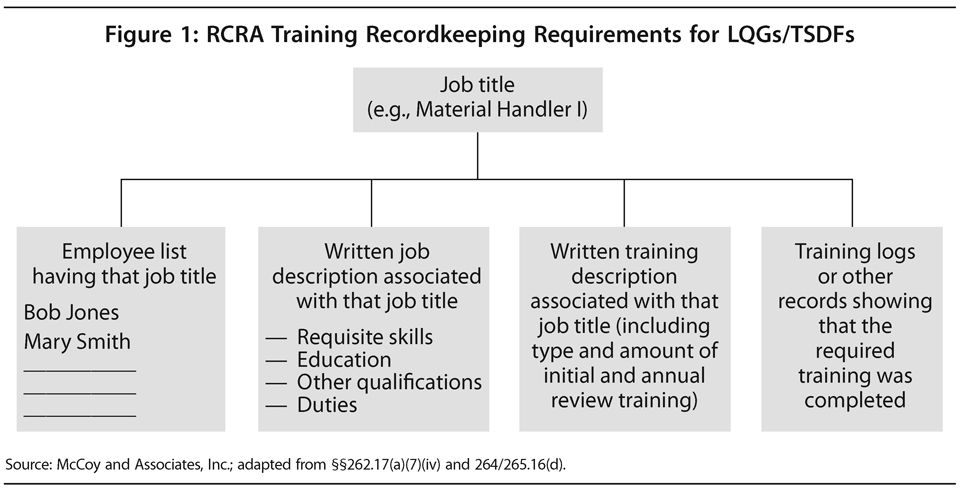
In enforcement actions, many RCRA training violations stem from failure to comply with recordkeeping requirements, rather than the content of the training program itself. LQGs must keep the following training records at the facility [§262.17(a)(7)(iv)]:
- The job title and name of each employee filling every position related to hazardous waste management. Job titles used to satisfy this requirement may or may not match those used for human resources purposes at the facility.
- A written job description (including the requisite skills, education level or other qualifications, and duties) for each position related to hazardous waste management; only duties directly related to hazardous waste management are typically included in these descriptions. This information allows EPA or the state to determine if each person is receiving a level of training that is commensurate with that person’s duties and responsibilities.
- A written description of the type and amount of initial and annual review training that will be given to each person filling a position related to hazardous waste management. Outlines of training programs or training matrices (similar to the example matrix presented in Table 1) are often used to fulfill this requirement. The minimum number of hours for the training program should be included in this description. If a facility designs its own training program to be implemented in-house or on-the-job, a detailed written account of the material to be presented for each position, the techniques to be used, and a schedule to be followed by the instructors should be on file.
- Records (including the dates of training) documenting that the required initial and all subsequent annual review training sessions have been successfully completed by facility personnel. Employee participation documentation such as tests, class lists with signatures, individual training logs, or spreadsheets are typically employed.
These four recordkeeping requirements are depicted in Figure 1. Training records for current personnel must be kept until the facility closes. For former employees, training records must be maintained for at least 3 years from the date the employee last worked at the facility. [§262.17(a)(7)(v)]
Small quantity generators
To reduce the administrative burden, EPA developed a simpler set of training requirements for SQGs. SQGs must “ensure that all employees are thoroughly familiar with proper waste handling and emergency procedures, relevant to their responsibilities during normal facility operations and emergencies.” [§262.16(b)(9)(iii)]
Very little guidance has been issued amplifying this provision. EPA noted in 1993 that SQG personnel that handle hazardous wastes should have training in proper waste handling and emergency procedures appropriate to the types of waste handled, the management methods used, and the hazards presented by the waste. In addition, there needs to be at least one employee either on the premises or on call with the responsibility for coordinating all emergency response measures. [RO 11779]
Waste identification, manifest requirements, accumulation time limits, proper tank and container management, and tank and container labeling should all be topics included in the SQG’s training program. Although not required by the regulations, a written training plan and records of employee names, training dates, and employee signatures would be helpful to demonstrate compliance with the training requirement.
Regarding emergency procedures, employees must be trained to be familiar with 1) communication and alarm systems and procedures such as contacting emergency response personnel (e.g., the fire department), 2) how to extinguish a fire, and 3) how to contain and clean up hazardous waste spills. [RO 11429] However, no recordkeeping requirements apply to SQG training, and there are no requirements for annual refresher training.
Does this mean all SQG employees, even clerical and office staff, need to be trained in hazardous waste management methods? EPA clarified this issue in the preamble to the March 24, 1986 SQG rule. “Employees who handle hazardous wastes as part of their normal job responsibilities or are likely to handle wastes in an emergency situation must be thoroughly familiar with proper waste handling and emergency procedures. Employees who work in or adjacent to areas where hazardous wastes are generated, handled, or stored, but do not handle hazardous wastes [e.g., office or clerical staff], must still be trained to be thoroughly familiar with basic emergency procedures.” [51 FR 10165]
Very small quantity generators
VSQGs do not have to comply with any RCRA training requirements per §262.14. [RO 14687]
TSDFs
Permitted and interim status TSDFs must train their employees in accordance with the requirements of §§264.16 and 265.16, respectively. The requirements in these two sections are identical and are essentially the same.
In accordance with §270.14(b)(12), information on employee training must be submitted as part of a RCRA Part B permit application. An outline of both the initial and continuing training programs for facility personnel must be included. The application must also contain a brief description of how training will be designed to meet actual job tasks in accordance with requirements in §264.16(a)(3).
Training not required in post-closure permits
When EPA added specific items to be included in applications for post-closure permits on October 22, 1998, the agency purposefully left out any requirements for training programs. EPA noted that, in the case of a post-closure permit, the facility will not be operating, so personnel training is not required. [63 FR 56728]
Universal waste handlers
EPA created less-stringent management requirements (including training provisions) for universal wastes handlers. Universal wastes include hazardous batteries, certain pesticides, mercury-containing equipment, lamps, and aerosol cans and are regulated under the Part 273 universal waste management standards. The level of training required for handlers’ personnel depends on how much universal waste is stored onsite at any one time. Large quantity handlers (i.e., those that accumulate >5,000 kg total universal waste onsite at any time) are subject to more-stringent requirements than small quantity handlers (i.e., those that never have 5,000 kg or more total universal waste onsite at any one time). Although training requirements are specified for such handlers, EPA noted, “Training that is required under other programs (such as OSHA or RCRA) will generally fulfill the Part 273 training requirements.” [July 6, 1999; 64 FR 36475]
The potential for overlap exists between the universal waste training requirements and the OSHA programs. EPA stated, “any training provided under other programs that would meet any or all of the Part 273 training requirements may be used to fulfill the RCRA requirements. As long as the substantive standards of the [RCRA] training provisions are met, the handler has fulfilled the training requirement. There is no requirement that training provided to meet the RCRA requirements be separate from other training given to employees.” [May 11, 1995; 60 FR 25528]
Employees at TSDFs who recycle, treat, or dispose of universal wastes remain subject to the full §264.16 or 265.16 training requirements.
Large quantity handler training standards
Large quantity handlers of universal waste “must ensure that all employees are thoroughly familiar with proper waste handling and emergency procedures, relative to their responsibilities during normal facility operations and emergencies.” [§273.36] This language is identical to that applicable to SQGs of hazardous waste. The preamble to the universal waste rule stated: “this does not require that any records be kept for training provided to employees, requires only that employees that have responsibilities for managing universal waste or for responding to emergencies be trained, and requires only that these employees be trained as is appropriate for their universal waste management responsibilities. Thus, employees who only minimally handle universal waste need only be trained to properly carry out that activity and to carry out their responsibilities, if any, in case of an emergency.” [May 11, 1995; 60 FR 25528]
No annual review of the initial employee training is required for large quantity handlers, unless the facility is also an LQG of hazardous waste. [RO 14598]
Small quantity handler training standards
The training requirements for small quantity handlers of universal waste are even less burdensome. These handlers are required only to inform all employees who handle or are responsible for managing universal waste of proper handling and emergency procedures for the types of universal waste handled at the facility. [§273.16] In the preamble to the May 11, 1995 universal waste rule, EPA stated that providing such information through oral communication is acceptable; however, the agency suggested that supplying employees with brochures and documents available from manufacturers, trade associations, etc. would probably be more effective. [60 FR 25528]
No annual review of the initial employee training is required, unless the facility is also an LQG of hazardous waste. [RO 14598]
Topic: NPDES Discharge Exclusion
©2024 McCoy and Associates, Inc. All rights reserved.
McCoy and Associates has provided in-depth information to assist environmental professionals with complex compliance issues since 1982. Our seminars and publications are widely trusted by environmental professionals for their consistent quality, clarity, and comprehensiveness.
Disclaimer
Considerable care has been exercised in preparing this document; however, McCoy and Associates, Inc. makes no representation, warranty, or guarantee in connection with the publication of this information. McCoy and Associates, Inc. expressly disclaims any liability or responsibility for loss or damage resulting from its use or for the violation of any federal, state, or municipal law or regulation with which this information may conflict. McCoy and Associates, Inc. does not undertake any duty to ensure the continued accuracy of this information.
This document addresses issues of a general nature related to the federal RCRA regulations. Persons evaluating specific circumstances dealing with the RCRA regulations should review state and local laws and regulations, which may be more stringent than federal requirements. In addition, the assistance of a qualified professional should be enlisted to address any site-specific circumstances.
